Blog


Phone Number
(843) 345-2415
Send Your Mail
darryl@thepoolcarepros.com
June 1, 2026
Your pool loses water every single day — the question is whether it's normal evaporation or a hidden leak. Here's the fast answer: a pool in the Charleston area should lose only about ⅛ to ¼ inch of water per day to evaporation, thanks to our high coastal humidity. If you're losing more than that — especially ½ inch or more per day, or you're adding water more than once a week — you most likely have a leak that needs attention.
That distinction matters more than most homeowners realize. Normal evaporation is just an inconvenience. A real leak quietly erodes the soil beneath your pool and deck, runs up your water bill, wastes chemicals, and - left unchecked - can turn a $300 repair into a $10,000 structural disaster.
This guide will show you exactly how to tell the difference, using the same methods our technicians use across Charleston, Goose Creek, Summerville, Mount Pleasant, North Charleston, and Moncks Corner. By the end, you'll know with confidence whether your pool is fine or whether it's time to call a professional.
Already losing more water than you should? Call (843) 345-2415 for professional leak detection across the Charleston Lowcountry.
Here's something most national pool articles get wrong for South Carolina homeowners: our humidity actually works in your favor when diagnosing a leak.
Evaporation happens when water molecules absorb enough energy to escape into the air. The drier the air, the faster this happens. In desert climates like Arizona or Nevada, pools can lose ⅜ to ½ inch per day — sometimes up to a full inch — purely from evaporation, with no leak at all.
The Charleston Lowcountry is the opposite. Our air is heavy with moisture. High humidity means the air is already saturated and can't hold much additional water vapor, which naturally suppresses evaporation. In humid climates like ours, daily evaporation typically falls between ⅛ and ¼ inch — closer to 1 to 1.5 inches per week.
What this means for you: Because evaporation is naturally low in our humid climate, water loss beyond ¼ inch per day is a stronger signal of a real leak here than it would be in a dry region. When a Charleston pool is dropping ½ inch or more daily, evaporation alone rarely explains it.
The exception is wind and heat. During a stretch of hot, breezy, low-humidity days — which we do get - evaporation can temporarily climb. That's why proper testing, not guesswork, is the only reliable way to know.
Let's put real numbers to it. Here's how normal evaporation compares across conditions:
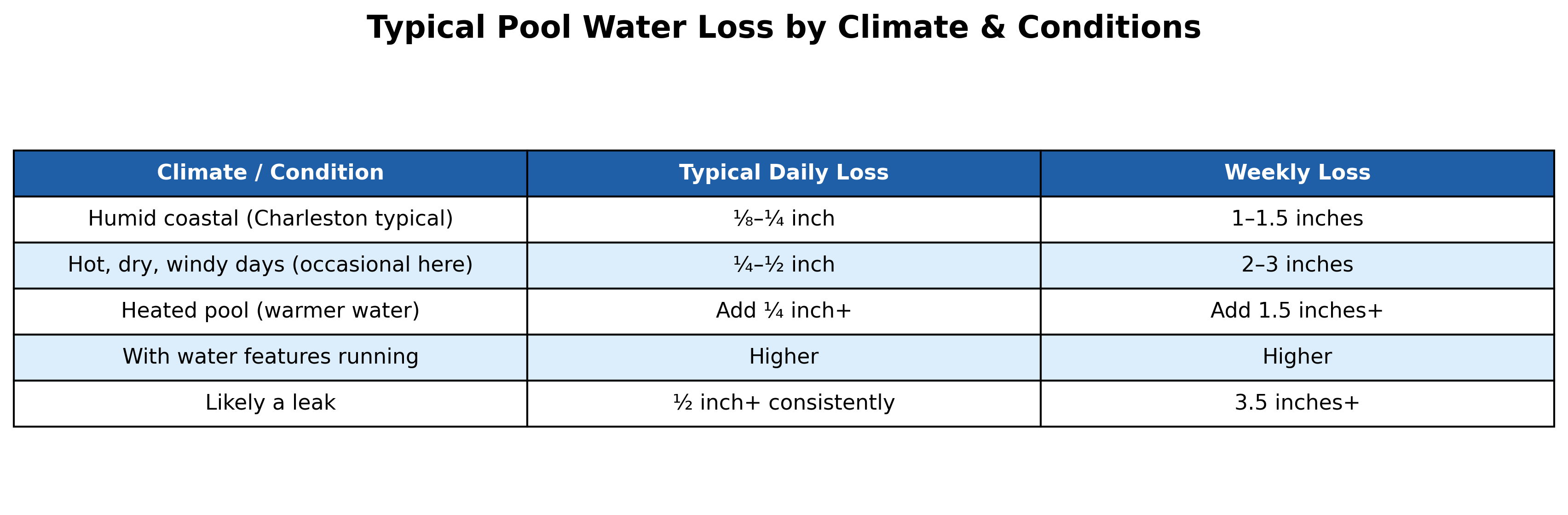
For a typical 20,000-gallon pool, a quarter inch per day equals roughly 100 to 300 gallons of normal evaporation loss per week. If you're replacing far more than that, the math points toward a leak.
A few factors that legitimately increase evaporation in Charleston:
Expert Tip: Evaporation drops significantly in cooler months. If your pool is losing noticeable water in fall, winter, or early spring — when our humidity is high and temperatures are mild — that's a strong indicator of a leak, not evaporation. Cool-season water loss is one of the clearest red flags we look for.
The bucket test is the simplest, most reliable DIY method to determine whether your pool's water loss is evaporation or a leak. It works on a simple principle: water in a bucket can only evaporate, while water in your pool can both evaporate and leak. If the pool loses more than the bucket, the difference is your leak.
Here's how to do it correctly:
Warning: Run the test when no rain is expected. Rain adds water to both the bucket and the pool unevenly and ruins the result. Also avoid extremely windy days, which can splash water out of both.
This is where you can actually narrow down where the leak is — and it's the step most homeowners skip. Run the bucket test twice:
Then interpret:
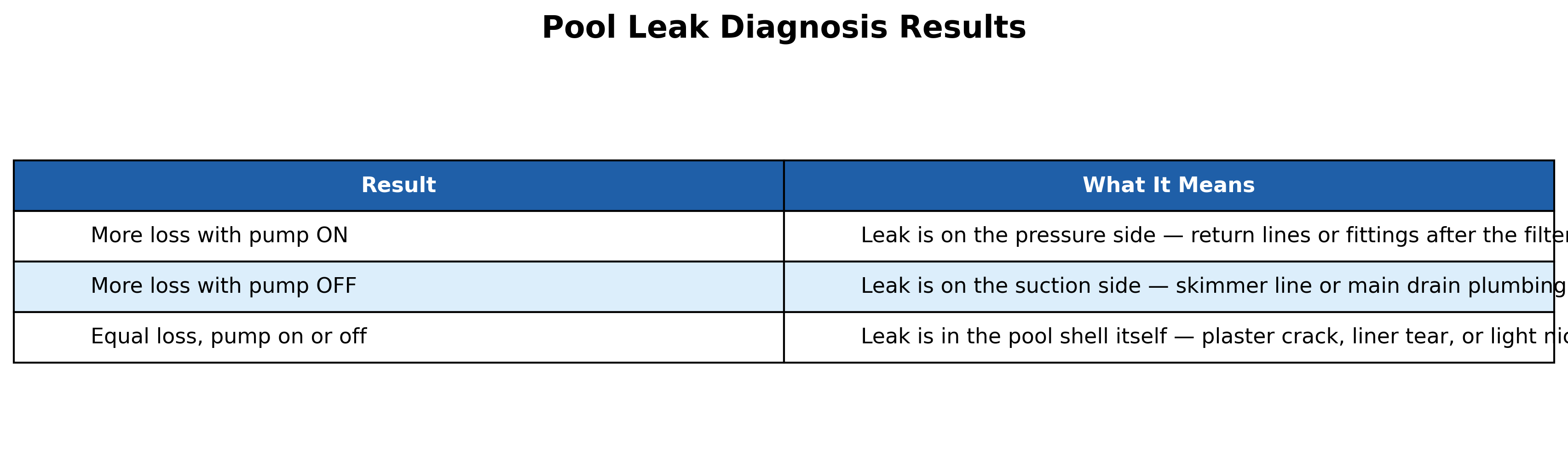
This information is genuinely useful to a leak detection professional — it tells us where to focus before we even arrive. When you call us, mentioning your bucket test results helps us diagnose faster.
Beyond the bucket test, these are the warning signs our technicians look for across Charleston-area pools:
Expert Tip: If your water level keeps dropping to a specific point and then stops, the leak is likely at that level. Stopping at the skimmer mouth points to a skimmer or return line issue. Stopping at the light suggests a leak around the light niche conduit. This is one of the fastest ways our technicians narrow down a leak's location.
When the bucket test confirms a leak, the next question is where. Pool leaks fall into three categories:
Cracks in the gunite or concrete shell, plaster damage, separated tile, failed expansion joints, or tears in a vinyl liner. In the Charleston Lowcountry, these are frequently driven by clay soil movement and hydrostatic pressure from our high water tables — especially in James Island, West Ashley, and parts of Goose Creek.
Return lines, suction lines, main drain plumbing, and skimmer lines run underground beneath your deck. These are the hardest leaks to find because the water escapes below the surface — sometimes surfacing far from the actual break. Causes include soil shifting, ground settling, and live oak root intrusion, which is extremely common across mature Charleston neighborhoods. Underground plumbing leaks require pressure testing to isolate.
Pump shaft seals, filter housing o-rings, valve gaskets, and heater connections. These are usually the easiest to spot — you'll often see dripping or pooled water at the pad — and the most affordable to repair. Charleston's salt air accelerates corrosion at these connection points.
A leak isn't just wasted water. Here's what it actually costs you — and why prompt detection saves money:
Warning: In Charleston's high-water-table areas, a structural leak is especially urgent. As water escapes and erodes supporting soil, the combination of ground movement and hydrostatic pressure can accelerate structural failure. What looks like a minor water-loss issue can undermine your entire pool and deck if ignored.
If the bucket test confirms a leak — or you simply want certainty — professional leak detection pinpoints the exact source without tearing up your yard. Here's the process we use:
The result: we find your leak precisely, then — unlike detection-only companies — we repair it, often the same day and frequently underwater without draining your pool.
Professional pool leak detection in the Charleston area typically costs $150 to $500, depending on pool size, complexity, and the methods required. We charge a fair flat fee — no surprise hourly billing.
Put that in perspective: a $300 detection that catches a structural leak early can prevent $5,000 to $10,000+ in soil erosion and structural damage down the line. Leak detection is one of the best-value services in pool ownership — the cost of finding a leak is always far less than the cost of ignoring one.
If your bucket test shows it's just evaporation, here's how to minimize it:
In the humid Charleston climate, normal evaporation is about ⅛ to ¼ inch per day, or roughly 1 to 1.5 inches per week. This is lower than dry climates because our high humidity suppresses evaporation. If you're losing more than ¼ inch per day consistently — especially ½ inch or more — you likely have a leak.
Overnight water loss is actually a useful diagnostic clue. Evaporation slows at night when temperatures drop and humidity rises, so significant overnight loss often points to a leak rather than evaporation. Run a bucket test over a full 24-hour period to confirm, and consider the pump-on versus pump-off test to narrow down the leak's location.
Run the bucket test: fill a 5-gallon bucket with pool water, place it on a step, mark both the bucket and pool water levels, turn off the autofill, and wait 24 hours. If the pool drops more than the bucket, you have a leak. The greater the difference, the bigger the leak. Other signs include a constantly running autofill, wet spots in the yard, and air bubbles in the return jets.
Professional pool leak detection in the Charleston area typically costs $150 to $500, depending on pool size and complexity. The PoolCare Pros charges a flat fee with no hourly surprises. Considering that an undetected structural leak can cause $5,000 to $10,000+ in soil erosion and structural damage, leak detection is a high-value investment.
Counterintuitively, rain can reveal a leak rather than cause one. After heavy rain saturates the ground, a struggling underground plumbing joint may shift or worsen. More commonly, homeowners notice continued water loss once the rain stops and assume the pool "should" be full. Run a bucket test on a dry day to get an accurate reading.
Some increased loss in summer is normal due to higher temperatures and occasional windy, lower-humidity days — but even in a Charleston summer, evaporation rarely exceeds ¼ to ½ inch per day. If you're losing significantly more, or topping off every couple of days, a bucket test will tell you whether it's the heat or a leak.
No. Pool leaks do not fix themselves — they get worse over time as water erodes surrounding soil, corrodes rebar, and widens cracks or joint separations. The longer a leak runs, the more expensive the repair becomes. Early detection is always the most cost-effective option.
The most common causes locally are clay soil movement (which separates underground plumbing joints), live oak root intrusion into pipes, salt air corrosion on equipment fittings, and structural cracks driven by high water tables and hydrostatic pressure. These Lowcountry-specific conditions make professional, locally experienced leak detection especially valuable.
In most cases, yes. Electronic listening, pressure testing, and dye testing locate leaks with the pool full. And most common leaks — shell cracks, fittings, skimmer seals, light niches — can be repaired underwater without draining. This is especially important in Charleston's high-water-table areas, where draining a pool carries its own structural risks.
Water loss is one of the most misdiagnosed pool problems. Some homeowners panic over normal evaporation; others dismiss a real leak as "just the heat" for months while it quietly damages their pool and deck. The bucket test gives you a reliable starting point — but when the result points to a leak, precise detection requires professional equipment and local expertise.
The PoolCare Pros has spent over a decade diagnosing and repairing pool leaks across the Charleston Lowcountry. We use Leaktronic electronic detection, pressure testing, and underwater repair capability to find your leak precisely and fix it — usually the same day, often without draining your pool. We understand the local conditions that cause leaks here: the clay soils, the high water tables, the salt air, the live oak roots. That local knowledge means faster, more accurate diagnosis.
Pool losing more water than it should? Call (843) 345-2415 for professional leak detection. We serve Charleston, Goose Creek, Summerville, Mount Pleasant, North Charleston, Moncks Corner, and the surrounding South Carolina communities. We diagnose first, explain honestly, and fix it right.
The PoolCare Pros — Goose Creek, SC 29445 | (843) 345-2415 | CPO Certified | Leaktronic Certified | PHTA Member | 12 Years Serving the Charleston Lowcountry | We treat every pool like it's our own.
Our Blog

© 2025 The PoolCare Pros. All Rights Reserved | By Wayo Media