Blog


Phone Number
(843) 345-2415
Send Your Mail
darryl@thepoolcarepros.com
July 21, 2026
Owning a pool in Charleston is different from owning one in almost any other part of the country. The same climate that draws people to the Lowcountry (the long summers, the mild winters, the lush coastal landscape) is also constantly working against your pool. Salt air corrodes equipment that would last years longer inland. Clay soils shift and crack structures. Live oak catkins, pine pollen, and palmetto fronds create debris loads that overwhelm filtration systems four seasons of the year. And when a hurricane comes through, an entire season's worth of damage can happen in one afternoon.
None of this means owning a pool here isn't worth it. It absolutely is: Charleston's 8 to 9 month swimming season makes a pool one of the most-used features in your home. But pool ownership here rewards homeowners who understand what they're working with, plan for the costs, and catch problems early instead of reacting to emergencies.
This guide covers the full picture: what owning a pool actually costs year-over-year, what Charleston's climate does to equipment and surfaces, the maintenance that matters most, the repairs you'll eventually face, how to handle storm season, when to call a professional, and how to protect the investment over 10, 15, and 20 years. Whether you're buying a home with a pool, building one, or have owned one for years, this is the reference you'll want bookmarked.
Before anything else, understanding the local environment is what separates pool owners who spend $500 a year on minor upkeep from those who spend $10,000 on emergency repairs. Every piece of advice in this guide traces back to one or more of these factors:
Salt air corrosion reaches 20+ miles inland, affecting pools in Goose Creek, Summerville, and Moncks Corner, not just barrier-island properties on Isle of Palms or Kiawah Island. It attacks every metal component: pump motor housings, heater cabinets, electrical terminals, valve stems, bonding wires, and rebar inside the pool shell wherever a crack exposes it. Salt air is the single biggest reason pool equipment in Charleston has a shorter lifespan than national averages.
An 8–9 month swimming season means your equipment logs nearly double the operating hours of a pool in Ohio or Minnesota. More run hours mean faster bearing wear, earlier seal failure, and compressed equipment lifespans across the board.
50+ inches of annual rainfall disrupts water chemistry constantly, introduces contaminants, and erodes soil around pool structures. A single afternoon thunderstorm can drop pH, dilute chlorine, and wash phosphate-rich organic matter into the pool.
Heavy organic debris from live oaks (which shed catkins in spring and drop leaves year-round), loblolly pines (pollen season from March through May is severe), azalea blossoms, and palmetto fronds creates one of the highest debris loads of any pool market in the country. Filters and baskets work overtime.
Clay-and-sand soils across the Lowcountry expand when wet and contract when dry. This constant movement cracks pool shells, separates plumbing joints, settles decks, and stresses bond beams. It's the leading cause of structural pool damage in Charleston.
High water tables (especially in James Island, West Ashley, parts of Goose Creek, and the peninsula) create hydrostatic pressure against pool shells. Draining a pool without proper relief in these areas can crack the floor or lift the pool out of the ground.
Humidity averaging 70%+ causes condensation inside motor compartments and electrical enclosures, degrading insulation and accelerating corrosion from the inside out.
Hurricane season (June–November) brings power surges, flooding, wind-driven debris, and saturated, shifting ground, all of which damage equipment, plumbing, and structure in ways that often aren't visible until you try to run the system.
The biggest mistake new pool owners make is budgeting only for the pool itself and not for the ongoing cost of keeping it running. Here's what ownership actually looks like annually:
Charleston sits at the higher end of national pool ownership costs because the extended season, chemical demand, and equipment wear add up. Pool owners who invest in a variable-speed pump, maintain balanced chemistry, and schedule annual professional inspections consistently spend less over a 10-year period than those who don't.
If you're purchasing a home with an existing pool, the most important step in your entire due diligence process is a dedicated pool inspection by a pool company, not your home inspector.
A home inspector checks roofing, HVAC, plumbing, electrical, and structure. For the pool, most perform a visual walkthrough and note that "the pool pump is running." That tells you nothing about whether the motor is drawing dangerous amperage, the heat exchanger is corroded, the plaster is delaminating, or the plumbing has a slow underground leak.
A professional pool inspection tests every piece of equipment under load, analyzes water chemistry (including the Langelier Saturation Index), evaluates structural integrity, and verifies safety code compliance: barriers, gates, drain covers, GFCI protection, and bonding. It costs $150–$300 and routinely catches $5,000–$25,000 in hidden problems that become negotiation leverage with the seller.
Key things to evaluate on any Charleston pool you're considering buying:
Schedule the pool inspection the same day you go under contract. Don't wait for the home inspection: pool inspections can be scheduled independently and should happen within the first 5–7 days of your contingency period.
Not all pool maintenance is equal. Some tasks are critical; others are nice-to-have. Here's what genuinely matters for pool longevity in the Lowcountry:
Unbalanced water chemistry causes more long-term damage than any other factor, more than salt air, more than storms, more than age. Corrosive water (low pH, low calcium) dissolves plaster and eats metal components from the inside. Scaling water (high pH, high calcium) clogs heat exchangers and salt cells. Neither shows obvious symptoms until the damage is expensive.
Test free chlorine and pH 2–3 times per week during swim season. Test total alkalinity, calcium hardness, and cyanuric acid weekly. After every heavy rain, which happens often here, retest and adjust. Charleston's rainfall dilutes and disrupts chemistry faster than in drier climates.
The number most homeowners don't know: the Langelier Saturation Index (LSI). This calculated index combines pH, temperature, calcium hardness, alkalinity, and TDS to tell you whether your water is corrosive, scaling, or balanced. A professional can calculate it during an inspection. It's the single most predictive number for surface and equipment longevity.
A dirty filter is the root cause of an astonishing number of pool problems. It restricts water flow, which causes heaters to shut down, pumps to overheat, and circulation to fail. Clean your pump and skimmer baskets weekly, more often during peak debris seasons (live oak catkin drop in February–March, pine pollen March–May, fall leaf drop October–November). Clean or backwash the filter when pressure rises 8–10 PSI above its clean baseline.
A 60–90 minute inspection at the start of pool season (February–April in Charleston) catches declining equipment, developing structural issues, and safety compliance problems before they become mid-season failures or emergency replacements. It's the cheapest insurance in pool ownership: a $250 inspection that prevents a $5,000 surprise.
Everything lasts shorter here. Here's what to realistically expect:
The takeaway: budget for replacements earlier than national guides suggest, and prioritize the maintenance that extends life: balanced chemistry, clean filters, and corrosion protection on exposed metal.
Every pool owner in Charleston will deal with most of these at some point:
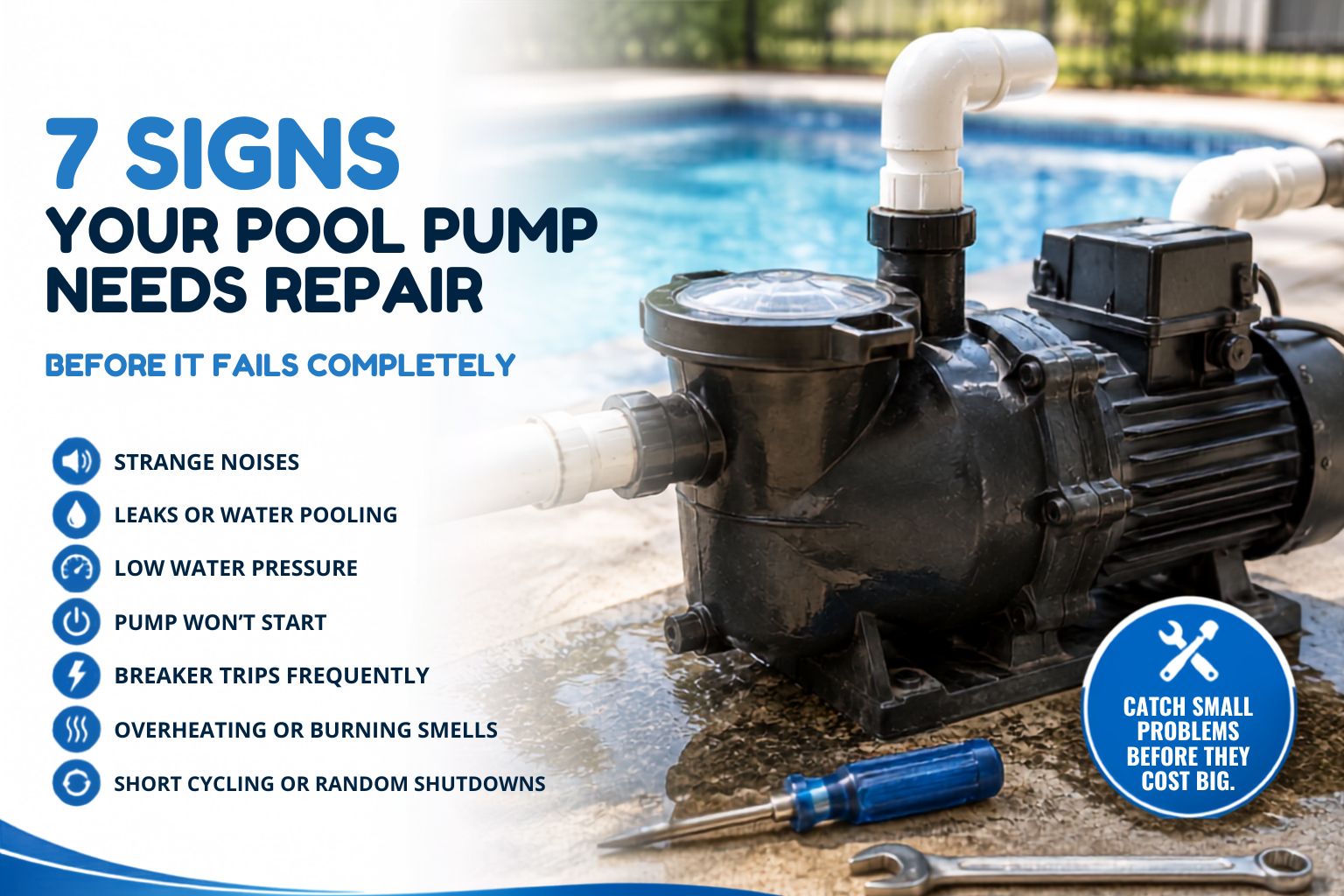
Pump repairs: bearing wear, capacitor failure, shaft seal leaks. The most common repair call. Costs $75–$600 depending on the component.
Leak detection and repair: structural cracks, plumbing leaks, equipment fitting failures. Detection runs $150–$500; repair $150–$2,500+ depending on location and severity.
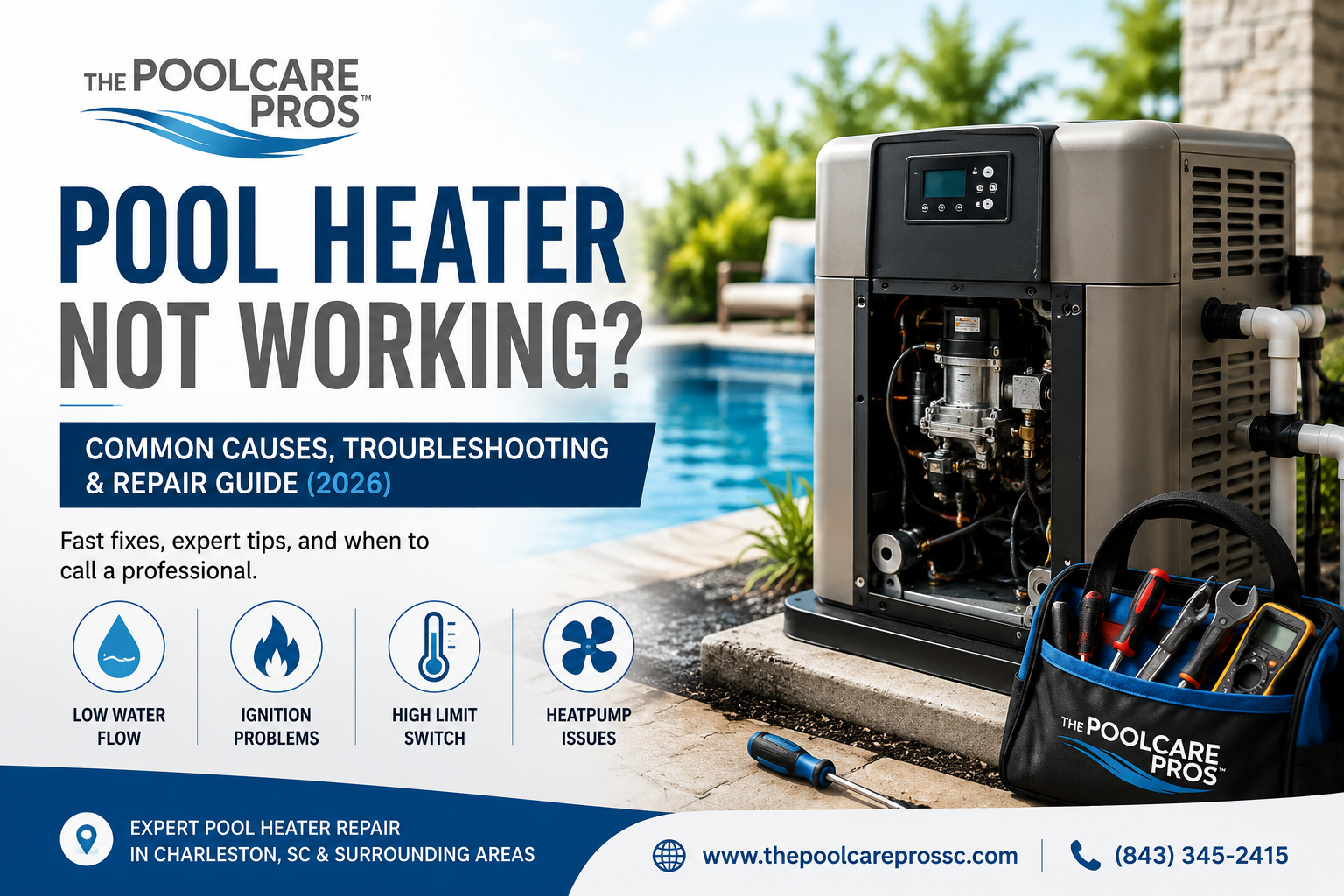
Heater problems: ignition failure, corroded heat exchangers, clogged burners from off-season pest nesting. Repair $100–$765; replacement $2,500–$6,000.
Structural damage: shell cracks, bond beam failure, deck settling. Driven by soil movement and hydrostatic pressure. Patch $100–$400; major structural repair $2,000–$8,000.
Surface deterioration: rough plaster, staining, delamination. Resurfacing $6,000–$15,000. Plaster lasts only 7–10 years here.
Salt system decline: cell scaling and depletion, control board failure. Cell $300–$800; board $200–$500.
The common thread: every one of these is cheaper to fix when caught early. A $200 pump repair becomes a $1,200 emergency replacement. A $300 leak repair becomes a $10,000 structural failure. Annual inspections and prompt attention to warning signs are consistently the most cost-effective approach to pool ownership.
This is uniquely critical for Charleston pool owners and something generic pool guides never cover adequately.
Post-storm inspection is not optional in coastal South Carolina. It's the difference between catching surge damage on a $200 control board relay and discovering three months later that the entire pump motor is fried.
South Carolina follows the International Swimming Pool and Spa Code (ISPSC), which requires:
There is no grandfathering exemption. An older pool is not exempt from current safety requirements, a common misconception in established Charleston neighborhoods where pools were built decades before current codes.
Most safety corrections cost $50–$500 individually. Total cost to bring a typical non-compliant older pool up to code is usually $300–$1,500. The safety inspection that identifies the gaps costs $250. If you're buying, selling, or insuring a home with a pool, non-compliant safety features can delay a closing, increase premiums, or create significant liability exposure.
Here's the practical framework:
Repair when the issue is isolated, the equipment is under 7 years old, the repair cost is well under 50% of replacement, and the pool's design and layout still work for you.
Renovate when multiple systems are failing simultaneously, the plaster needs resurfacing, equipment is past its expected lifespan, and you want to modernize (variable-speed pump, automation, LED lighting, salt system, water features).
Renovation is the ideal time to make efficiency upgrades that pay for themselves: a variable-speed pump saves $600–$1,200/year in electricity, LED lighting cuts 80% of light energy, and automation reduces chemical waste through precise scheduling.
The best renovation window in Charleston is October through March: off-season, lower demand, easier scheduling, and the pool is ready by the April swim season.
Pool ownership is a 20+ year commitment. The homeowners who get the most value, financially and recreationally, are the ones who treat it as a system, not a collection of unrelated parts.
The five highest-impact things you can do:
Total annual pool ownership costs in the Charleston area typically range from $4,400 to $11,500, depending on pool size, equipment type, and whether you use professional maintenance. This includes chemicals ($800–$1,500), electricity ($1,200–$3,000), water ($200–$600), professional service if used ($1,200–$3,600), repairs ($300–$800), insurance ($100–$500), and setting aside money for eventual resurfacing.
Pools typically add 5–8% to home value in warm climates like Charleston, where the swimming season is 8–9 months. A well-maintained pool in move-in condition adds value; a neglected pool with aging equipment and rough plaster can reduce buyer interest. A pre-listing pool inspection and any necessary repairs are worth the investment before selling.
Charleston's effective swimming season runs from April through October for unheated pools, and year-round for heated pools. Many homeowners heat through the shoulder months (March–April and November) to extend the season. Heat pumps are the most efficient heating option for our mild winters, and the extended season is a key reason pools are used more, and wear faster, here than nationally.
Yes, measurably. Charleston's combination of high heat, high humidity, heavy rainfall, extreme debris loads (live oaks, pine pollen, palmetto fronds), and salt air creates higher chemical demand, faster equipment corrosion, and more aggressive algae growth than inland or northern markets. A pool that's easy to maintain in a dry, mild climate requires significantly more attention here.
Strongly recommended. A home inspection does not adequately evaluate a pool. A dedicated pool inspection tests equipment under load, analyzes water chemistry, evaluates structural integrity, and checks safety compliance, routinely uncovering $5,000–$25,000 in hidden problems that become negotiation leverage. The inspection costs $150–$300 and should be scheduled during the first week of your contingency period.
Do not drain the pool: the water's weight prevents hydrostatic damage. Shut down equipment at the breaker, turn off gas, remove loose items, superchlorinate, and lower the water level a few inches to absorb rainwater. After the storm, have equipment inspected before running, since surge and flood damage often hides. Remove debris manually before running the pump.
Both work well here. Salt systems reduce chemical handling and produce softer-feeling water, but the cell needs replacement every 3–4 years ($300–$800) and Charleston's hard, mineral-rich water accelerates scaling. Traditional chlorine requires more hands-on dosing but has lower equipment costs. The 5-year total cost of ownership is roughly similar; the choice comes down to preference and maintenance style.
Pump failures (accelerated by salt air and extended run hours), leaks (driven by soil movement and plumbing aging), heater corrosion (salt air attacks heat exchangers), surface deterioration (UV and mineral water shorten plaster life), and structural cracking (clay soil movement and hydrostatic pressure). Annual professional inspections catch most of these early.
Test free chlorine and pH 2–3 times per week during swim season, and after every significant rain event. Test total alkalinity, calcium hardness, and cyanuric acid weekly. In Charleston's climate, where heat and rain rapidly shift chemistry, consistent testing prevents the kind of chronically imbalanced water that silently destroys equipment and surfaces.
Pebble and quartz-aggregate finishes last 12–18 years locally, compared to 7–10 years for standard plaster. They resist staining, etching, and calcium nodule formation better under Charleston's UV exposure and mineral-rich water. Standard plaster can work on a tighter budget but expect shorter lifespan and earlier resurfacing.
Pool ownership in Charleston is a commitment: to the maintenance, the costs, and the awareness that our climate is constantly working on your equipment and structure. But it's a commitment that pays back every warm afternoon from April through October (and beyond, if you heat). The homeowners who get the most value treat their pool as a system that rewards attention, not a problem they react to. Balanced chemistry, annual inspections, prompt repairs, and planned equipment replacement are not luxuries. They're the foundation of 20+ years of enjoyment without surprise five-figure bills.
Have a question about your pool, or want a professional assessment of where your equipment and structure stand? Call (843) 345-2415. The PoolCare Pros has served the Charleston Lowcountry for over 16 years. We diagnose first, explain honestly, and fix it right. We serve Charleston, Mount Pleasant, Summerville, Goose Creek, North Charleston, Daniel Island, James Island, Johns Island, Isle of Palms, Kiawah Island, Moncks Corner, and the surrounding communities.
The PoolCare Pros, Goose Creek, SC 29445 | (843) 345-2415 | CPO Certified | Leaktronic Certified | PHTA Member | 16+ Years Serving the Charleston Lowcountry | We treat every pool like it's our own.
Our Blog

© 2025 The PoolCare Pros. All Rights Reserved | By Wayo Media