Blog


Phone Number
(843) 345-2415
Send Your Mail
darryl@thepoolcarepros.com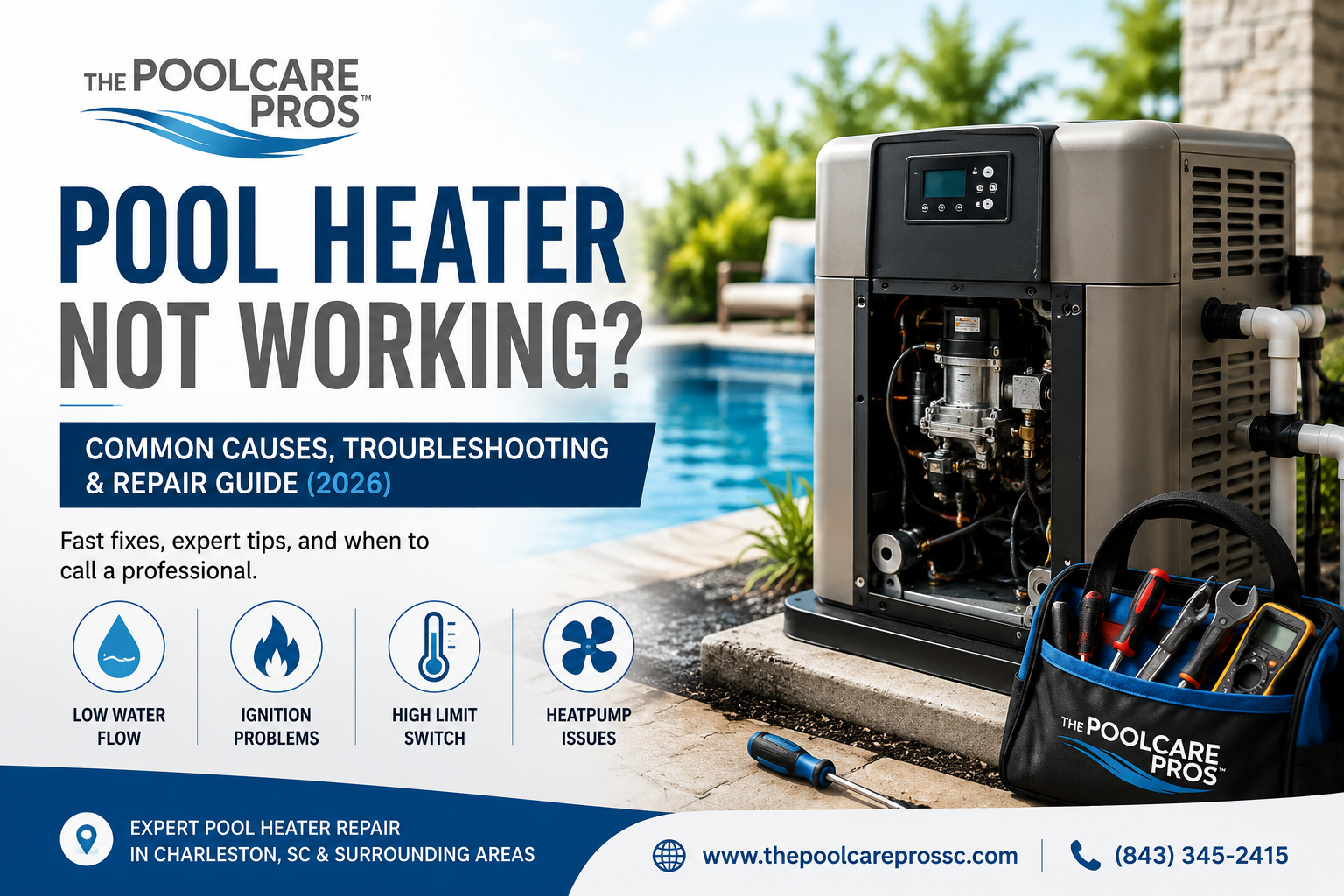
July 12, 2026
If your pool heater isn't working, the most common cause is low water flow- usually from a dirty filter or clogged pump basket - followed by ignition problems, a tripped high-limit switch, or a faulty thermostat. Many of these have quick fixes you can check yourself in under an hour. Others, especially anything involving gas or electrical components, require a professional.
This guide is built to get you to an answer fast. We'll start with a 60-second safety checklist, then work through every common heater problem by symptom - heater won't turn on, turns on but won't heat, cycles on and off, displays an error code - for both gas heaters and electric heat pumps. We'll tell you what you can safely check yourself, what needs a technician, what repairs typically cost, and when replacement makes more sense than repair.
We'll also cover something no national guide addresses: why pool heaters in the Charleston Lowcountry fail differently and faster than heaters anywhere else, and what that means for diagnosis.
Heater down and not sure what's wrong? Call (843) 345-2415. We diagnose and repair pool heaters across Charleston, Mount Pleasant, Summerville, Goose Creek, North Charleston, and the surrounding South Carolina communities.
Before diving into specific problems, run through these five basics. A surprising number of "broken" heaters are simply not getting power, water, or gas.
If all five check out and the heater still won't work, you have a real component issue. Read on by symptom.
Warning: If you ever smell gas near the heater, stop. Do not operate any electrical switches. Leave the area and call your gas utility's emergency line first, then a pool professional. A gas smell is a life-threatening emergency, not a troubleshooting step.
Pool heaters fall into two main types, and they fail in completely different ways. Knowing which you have changes the entire diagnosis.
In the Charleston area, both types are common. Gas heaters dominate where homeowners want fast heating or have spas; heat pumps are popular for their efficiency given our long swimming season. We'll cover both throughout this guide.
If the heater shows no signs of life - no display, no ignition attempt, nothing - the issue is almost always power, water flow, or a safety interlock preventing startup.
Likely causes:
What you can safely check:
What needs a professional: Flow switch replacement, high-limit switch diagnosis, and control board repair. These involve electrical testing and components that require accurate diagnosis.
Typical repair cost: $100–$400 depending on the component (flow switch, high-limit switch, or board-level repair).
This is the single most common heater complaint - the heater appears to run, but the water stays cold. The number one cause is inadequate water flow.
Low water flow (the #1 cause). Pool heaters need a steady, adequate flow of water to transfer heat. Most gas heaters require at least 40 gallons per minute. When flow drops, the heater either won't transfer heat effectively or shuts down to protect itself. The usual sources of low flow:
Thermostat or temperature sensor fault. If flow is good but the heater still won't reach temperature, the thermostat may be faulty or a temperature sensor may be misreading.
What you can safely check: Clean the filter, empty baskets, confirm valves are open, verify the thermostat setting, and (for heat pumps) make sure the unit has 3 feet of clearance and a clean coil exterior.
What needs a professional: Ignition components, gas valve, heat exchanger, flame sensor, refrigerant issues, compressor, and fan motor. Gas and refrigerant work is never DIY.
Typical repair cost: Flame sensor $20–$200; ignitor/ignition module $100–$400; gas valve $175–$600; heat exchanger $500–$1,500; heat pump fan motor $200–$500; refrigerant/compressor work $400–$1,500+.
A heater that fires up, runs briefly, then shuts off - over and over - is "short cycling." This is almost always a protective shutdown triggered by one of these:
What you can safely check: Clean the filter and baskets, confirm proper flow.
What needs a professional: Flame sensor cleaning/replacement, high-limit switch, pressure issues, and any electrical connection problem.
Typical repair cost: $100–$400 depending on the component.
Expert Tip: Before assuming your heater is broken, clean your filter and check filter pressure. In our experience servicing pools across the Lowcountry, a significant share of "broken heater" calls turn out to be a dirty filter starving the heater of flow. It's the cheapest possible fix - and worth ruling out first.
Modern gas heaters and heat pumps display fault codes that point directly to the problem. Code meanings vary by brand (Pentair, Hayward, Jandy, Raypak each use their own), but common categories include:
Note the exact code before calling. It dramatically speeds up diagnosis. If the code points to gas, refrigerant, or repeated ignition failure, that's a professional repair.
Here's what generic national troubleshooting guides miss entirely: our climate is unusually hard on pool heaters. Understanding these local factors helps explain why heaters here need more attention.
Salt air corrosion. This is the big one. Coastal salt air - which reaches well inland to Goose Creek, Summerville, and North Charleston, not just the barrier islands - aggressively corrodes the metal components every heater depends on. Gas heater cabinets and heat exchangers corrode from the outside in. Heat pump coils and fan components degrade. Electrical terminals and control boards corrode, causing intermittent faults that are maddening to diagnose. Salt air is the single biggest reason Charleston heaters have shorter lifespans than the national average.
Coastal humidity. Sustained high humidity drives condensation inside heater cabinets and electrical enclosures, accelerating corrosion and electrical faults.
Extended swimming season. Charleston pools run 7 to 9 months a year, and heaters extend that further into the shoulder seasons. More run time means more wear on every component.
Storm and surge damage. Hurricane season brings power surges that destroy control boards and flooding that submerges and ruins heaters. After any major storm, a heater should be inspected before use - surge damage often hides until you try to run the unit.
Off-season pest intrusion. When gas heaters sit unused, insects and small animals nest inside, clogging burners and orifices. This is a routine Lowcountry service issue we see every spring at startup.
The practical takeaway: a heater that might last 12 years in a dry inland climate often lasts 5 to 10 years here. Annual professional service - ideally at spring startup - catches corrosion and wear before they cause a mid-season failure.
When a heater problem turns out to be a major repair, the repair-or-replace question comes up. Here's how to think about it.
Repair makes sense when:
Replacement makes sense when:
Cost context: General heater repairs run $160–$765. A corroded heat exchanger replacement alone can run $500–$1,500. A new heater installed costs $2,500–$6,000 depending on type and size. When a $1,500 heat exchanger repair is needed on a 9-year-old heater, replacement is usually the smarter long-term investment - especially given how salt air will continue to attack the old unit.
Honest recommendation: We diagnose before we recommend. Sometimes the fix is a $150 flame sensor and the heater has years of life left. Sometimes it's a corroded exchanger on an aging unit where replacement saves money over time. A proper diagnosis - not a guess - is the only way to know which situation you're in.
In the Charleston Lowcountry: gas heaters typically last 5 to 10 years, and electric heat pumps 8 to 12 years. These are shorter than national averages because of salt air corrosion, high humidity, and extended run times. You can maximize lifespan by:
Some heater troubleshooting is safe for homeowners - cleaning the filter, emptying baskets, checking the thermostat, resetting a breaker once, confirming the gas valve is open. But call a professional for anything involving:
A diagnostic service call is a small investment that prevents misdiagnosis, protects your warranty, and - with gas and electrical systems - keeps you safe.
Related services: Heater problems are often connected to other equipment. If low flow is the cause, the issue may be your pool equipment or a pool repair need. If you're buying a home, a pool inspection tests the heater under load before you own it.
The most common reason a pool heater runs but won't heat is inadequate water flow, usually from a dirty filter or clogged pump basket. Other causes include a faulty thermostat, a clogged or corroded heat exchanger, ignition problems (gas heaters), or low refrigerant (heat pumps). Start by cleaning your filter and checking that the pump is running at full strength - if filter pressure is 8–10 PSI above its clean baseline, that's likely your problem.
A heater that short cycles - fires up then shuts off repeatedly - is almost always protecting itself from low water flow. Clean your filter and baskets first. Other causes include a faulty high-limit switch, a dirty or failed flame sensor (gas heaters, if it shuts off within seconds of igniting), high water pressure, or a loose electrical connection. If cleaning the filter doesn't resolve it, the issue is likely a component that needs professional diagnosis.
Low water flow is the most common pool heater problem, and a dirty filter is the most common cause of low flow. Because heaters need a steady stream of water to operate, anything that restricts flow - a clogged filter, a dirty pump basket, or a weak pump - will cause the heater to either not heat or shut off on its safety switch. It's also the cheapest problem to fix, which is why it's worth checking first.
Pool heater repair typically costs $160 to $765 including labor, depending on the component. Common repairs: flame sensor $20–$200, ignitor or ignition module $100–$400, gas valve $175–$600, heat exchanger $500–$1,500, and heat pump fan motor $200–$500. A diagnostic service call runs about $75–$150. Refrigerant and compressor work on heat pumps is at the higher end.
Repair if the heater is under 5–7 years old and the failed component is affordable relative to a new unit (under 50% of replacement cost). Replace if the heater is 8+ years old, the heat exchanger is corroded or cracked, or you're facing multiple failures. A new heater installed costs $2,500–$6,000. In Charleston's salt air, an aging heater facing a major repair like a heat exchanger replacement is usually better replaced.
In the Charleston Lowcountry, gas heaters last 5 to 10 years and electric heat pumps last 8 to 12 years - shorter than national averages because of salt air corrosion, humidity, and long swimming seasons. Maintaining balanced water chemistry, keeping the filter clean, and scheduling annual service significantly extends heater lifespan.
Yes - a dirty filter is one of the most common causes of heater problems. Heaters require adequate water flow to operate, and a clogged filter restricts that flow. The result is a heater that won't heat properly or short cycles (shuts off repeatedly) to protect itself from overheating. If your heater is acting up, cleaning the filter is the first and cheapest thing to try.
It depends on the heater's age and the repair. A minor repair (flame sensor, thermostat, flow switch) on a heater under 7 years old is absolutely worth it. A major repair (corroded heat exchanger) on a heater 8+ years old usually isn't - replacement is the smarter long-term investment, especially in salt air that will keep attacking the old unit. An honest professional diagnosis tells you which situation applies.
A gas heater that won't ignite usually has a problem with gas supply, the ignitor, the flame sensor, the burners, or venting. First confirm the gas valve is open and (for propane) the tank isn't empty. Then check that water is flowing and the thermostat is set above current water temperature. If those are fine, the ignition system needs professional service - gas components are not safe to troubleshoot DIY.
Yes, significantly. Salt air aggressively corrodes the metal components heaters depend on - cabinets, heat exchangers, heat pump coils, electrical terminals, and control boards. This is why pool heaters in coastal South Carolina, including inland areas like Goose Creek and Summerville that still get salt air, have shorter lifespans than the national average. Annual professional service helps catch corrosion before it causes failure.
When your pool heater stops working, resist the urge to panic or immediately price replacements. Run the 60-second checklist first - power, water flow, gas, thermostat, error code. Clean your filter. A large share of heater problems trace back to flow issues that cost nothing to fix.
But know your limits. Gas components, refrigerant systems, electrical connections, and heat exchangers require a professional - both for safety and to avoid misdiagnosis that wastes money. And in the Charleston Lowcountry, where salt air and long seasons wear heaters faster than almost anywhere, an annual professional service at spring startup is the best way to avoid a cold-water surprise in the middle of the season.
Pool heater still not working after the basics? Call (843) 345-2415. We diagnose first, explain honestly what's wrong, and tell you whether repair or replacement makes more sense. We serve Charleston, Mount Pleasant, Summerville, Goose Creek, North Charleston, and the surrounding Lowcountry.
Our Blog

© 2025 The PoolCare Pros. All Rights Reserved | By Wayo Media