If you're under contract on a Charleston home with a pool, get a professional pool inspection before your inspection contingency expires. Not from your home inspector — from a pool company that tests every piece of equipment under load, analyzes water chemistry, evaluates structural integrity, and gives you a written report with repair cost estimates you can hand to your real estate agent.
A standard home inspection does not adequately cover a swimming pool. Home inspectors are generalists. They check roofing, HVAC, plumbing, electrical, and foundation. When it comes to the pool, most perform a visual walkthrough and note that "the pool pump is running" — which tells you nothing about whether the motor is drawing dangerous amperage, the heater exchanger is corroded from a decade of salt air, the plumbing has a slow underground leak, or the plaster is six months from delamination.
That gap between what a home inspector checks and what a pool actually needs is where $5,000 to $25,000 in hidden repair costs live. A $150 to $300 pool inspection finds them before you own them.
Closing soon? Call (843) 345-2415 to schedule a pre-purchase pool inspection before your inspection contingency expires.
Do You Need a Pool Inspection When Buying a House?
Yes — and especially in Charleston. Here's why.
The average residential pool in the Lowcountry is 12 to 20 years old. That means the plaster may be approaching or past its expected lifespan (7 to 10 years in Charleston's climate). The pump and heater were likely installed with the pool and may be nearing replacement. The underground plumbing has endured decades of clay soil movement. And every metal component — motor housings, heater cabinets, electrical connections, valve stems — has been breathing salt-laden coastal air for its entire life.
You can't see any of this from the pool deck during a showing.
Here's what a pool inspection changes:
- It reveals what the showing hides. A pool can look crystal clear and functioning perfectly while hiding $12,000 in repair needs. We've inspected pools in Mount Pleasant where the water was pristine and the pump was 90 days from catastrophic failure — drawing 14 amps on a motor rated for 9.
- It gives you documented negotiation leverage. A professional inspection report with itemized findings and estimated repair costs isn't just information — it's a negotiation tool your agent can use to request seller credits, price reductions, or pre-closing repairs.
- It protects you from the most expensive surprise in home buying. A bad roof might cost $8,000 to $15,000. A bad pool can cost the same — or more — and unlike a roof, there's no easy way to assess it without specialized testing.
The inspection costs $150 to $300. The problems it catches cost $5,000 to $25,000+. That ratio makes a pool inspection the cheapest insurance policy in real estate.
Why a Home Inspector Is Not Enough for Your Pool
This is the most critical point in this entire guide, and the one most Charleston home buyers miss.
Your home inspector will walk the pool area. They'll note that the pump turns on, the water looks clear, and the fence appears intact. That's the extent of it. Here's what they typically don't do:
- They don't test equipment under load. Your pool pump "running" tells you nothing. A pool professional measures amperage draw with a clamp meter. If a motor rated for 9 amps is drawing 13, that motor has months — not years — of life left. Your home inspector won't catch this.
- They don't analyze water chemistry. Beyond a basic "water looks clear," a pool inspector tests free chlorine, pH, total alkalinity, calcium hardness, cyanuric acid, salt levels, and calculates the Langelier Saturation Index (LSI) — a measurement that reveals whether the water is actively corroding the plaster and metal components or scaling the heater and salt cell. An unbalanced LSI doesn't show up as cloudy water. It shows up as a $6,000 replastering job two years from now.
- They don't evaluate structural integrity. A pool professional taps the plaster to find delamination (hollow spots where the finish has lifted from the shell). They inspect cracks for depth and movement. They check the bond beam, the coping-to-deck junction, and the expansion joint. Your home inspector looks at the pool surface and moves on.
- They don't pressure-test plumbing. The suction and return lines run underground beneath your deck. A slow plumbing leak wastes water, erodes soil, and can undermine your deck — but it produces no visible symptoms on the pool surface. Pressure testing isolates each line to confirm integrity. Home inspectors don't carry pressure testing equipment.
- They don't check code compliance in depth. A pool professional verifies VGB-compliant drain covers (federal safety requirement), GFCI protection on all pool circuits, barrier gate function (self-closing, self-latching, correct direction), and bonding/grounding on pool lights. A home inspector notes the fence exists. That's not the same thing.
The bottom line: A home inspection tells you the pool appears functional. A pool inspection tells you its actual condition, remaining lifespan, and what it will cost you over the next 1, 3, and 5 years. When you're about to spend $450,000 to $1.2 million on a Charleston home, the difference matters.
What Does a Pool Inspection Include?
A professional pre-purchase pool inspection covers four primary areas. Here's exactly what we evaluate in each:
1. Structural Assessment
This is the physical integrity of the pool itself — the part that holds 20,000+ pounds of water.
What we check:
- Pool shell (gunite, shotcrete, or fiberglass) for cracks, chips, and settlement
- Plaster surface for roughness, etching, delamination, calcium nodules, and staining
- Tile line for loose, missing, or cracked tiles
- Coping for separation from the bond beam (a major indicator of soil movement)
- Bond beam integrity (the reinforced concrete rim that supports coping and tile)
- Pool deck for settling, cracking, and separation from the pool edge
- Expansion joint between deck and pool (missing or failed joints are the #1 cause of bond beam cracking in Charleston)
What we find in Charleston specifically:
This is where local knowledge becomes irreplaceable. Charleston's Lowcountry geology creates structural issues that a generic inspection would miss:
- Clay soil movement. Charleston sits on Coastal Plain soils heavy in expandable clay. These soils swell when saturated (which is often — we average 50+ inches of rain per year) and shrink during dry periods. This push-pull applies uneven pressure to the pool shell and separates plumbing joints at their connection points. We check for settlement patterns, deck separation, and plumbing stress at the deck-to-pool junction.
- Hydrostatic pressure. In James Island, West Ashley, parts of Goose Creek, and much of the Charleston peninsula, the water table sits just 2 to 4 feet below grade. This creates upward pressure against the pool floor — especially if the pool was ever drained without proper hydrostatic relief. We check the hydrostatic relief valve and inspect the floor for pressure cracks.
- Bond beam failure from soil-driven deck movement. We see this frequently in Summerville, Daniel Island, and Johns Island neighborhoods built in the 2000s where rapid development sometimes meant less-than-ideal soil compaction. The deck expands and pushes against the pool beam, cracking it and lifting the tile line. Bond beam repair runs $4,000 to $6,000 for a full perimeter.
2. Equipment Testing
Every piece of equipment on the pad gets tested under operating conditions — not just visually checked.
What we test:
- Pump: Amperage draw, flow rate, noise level, seal condition, impeller inspection
- Filter: Pressure differential (clean vs. operating), manifold integrity, media condition
- Heater: Ignition sequence, temperature rise, heat exchanger condition, error codes
- Salt chlorine generator: Independent cell output test (not just what the control board reports), cell scaling inspection, salt level verification
- Automation: Full cycle of all programmed functions, relay testing, sensor calibration
- Valves: Multiport, check valves, diverter valves — function and leak check
- Pool lights: Operation, GFCI protection, bonding/grounding integrity
What we find in Charleston specifically:
- Salt air corrosion on every metal surface. Even in Goose Creek and Summerville — 20+ miles from the coast — salt aerosol corrodes motor housings, heater cabinets, wiring terminals, and electrical junction boxes. We score corrosion severity on every metal component. A heater that "looks fine" may have a heat exchanger corroded to the point of failure inside.
- Oversized single-speed pumps. Many Charleston pools installed in the 2005–2015 era have oversized single-speed pumps that waste $100+/month in electricity. We note pump sizing so you can factor a variable-speed upgrade ($900–$1,500 installed) into your offer or post-purchase budget.
- Aging equipment on 15–20 year old homes. Neighborhoods like Park West (Mt. Pleasant), Crowfield Plantation (Goose Creek), Wescott Plantation (Summerville), and The Farms at Stono Ferry (Hollywood) were built with original pool equipment that's now approaching or past its expected lifespan. Equipment replacement for pump, heater, and salt system together can run $3,000 to $5,000.
3. Water Chemistry & Sanitization Analysis
Water chemistry reveals the history of how the pool has been maintained — or neglected.
What we test:
- Free chlorine and combined chlorine (chloramines)
- pH level
- Total alkalinity
- Calcium hardness
- Cyanuric acid (stabilizer)
- Salt level (if salt system)
- Metals (copper, iron — staining indicators)
- Langelier Saturation Index (LSI): This calculated index tells you whether the water is corrosive (attacking plaster and metal), scaling (depositing calcium on heater and salt cell), or balanced. It's the single most important number most homeowners have never heard of.
What chemistry tells us about the pool's past:
- Chronically low pH + low calcium hardness = aggressive water that has been dissolving the plaster surface for years. The plaster may feel smooth now but it's thinner than it should be and approaching failure.
- High calcium + high pH = scaling water that has been depositing minerals on the heater exchanger and salt cell, reducing their efficiency and lifespan.
- High cyanuric acid (above 80 ppm) = the pool has been using stabilized chlorine tablets without draining and diluting, which reduces chlorine effectiveness and requires partial drain to correct.
These aren't problems that show up in a visual walkthrough. They require testing.
4. Safety & Code Compliance
Safety violations are both a liability risk and a negotiation point.
What we verify:
- Barrier fencing: 48-inch minimum height, gap compliance (no 4-inch sphere passage), no climbable features within 36-inch clear zone
- Gates: Self-closing function, self-latching mechanism, outward opening direction, latch height (54+ inches exterior)
- Door alarms: UL 2017 compliance on any house door providing direct pool access
- Drain covers: VGB compliance (ANSI/APSP-16), installation date, expiration date, physical condition
- GFCI protection: All pool circuits tested
- Pool lighting: Bonding and grounding verification
- Electrical: Equipment pad wiring inspection, corrosion check on connections
What we find in Charleston specifically:
- Gate springs corroded from salt air. Self-closing mechanisms fail more frequently in the Lowcountry than anywhere inland. A gate that was compliant at installation may no longer self-close or self-latch.
- Pre-VGB drain covers. Pools built before 2008 commonly have original drain covers that don't meet federal anti-entrapment standards. Replacement covers cost $45–$100.
- Corroded bonding connections. Salt air attacks copper bonding wires and their connections to pool lights and metal components. Corroded bonding is invisible but creates electrocution risk. This is the most dangerous finding we encounter, and it requires an electrician to repair.
How Much Does a Pool Inspection Cost in Charleston?
A professional pre-purchase pool inspection in the Charleston area typically costs $150 to $300, depending on:
- Pool size and complexity: A standard residential pool with pump, filter, and heater falls at the lower end. Pools with salt systems, automation, spas, water features, or multiple equipment systems fall at the higher end.
- Accessibility: Pools with restricted equipment access (common in Charleston's historic neighborhoods and tight lot lines in downtown and South of Broad) may take longer.
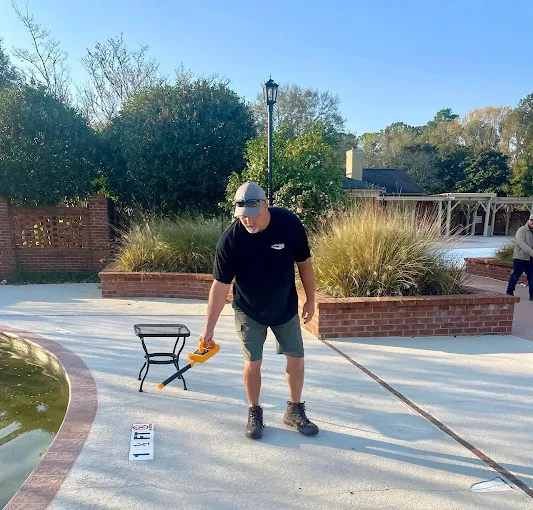
- Additional testing: Leak detection (using Leaktronic electronic equipment) is a separate service if warranted by inspection findings.
Cost context: The inspection costs $150 to $300. The problems it catches typically involve:
| Problem Found |
Typical Repair Cost |
Without Inspection... |
| Pump nearing failure (high amperage) |
$400–$1,200 replacement |
You pay after closing |
| Corroded heater exchanger |
$800–$2,500 replacement |
Heater dies first winter |
| Slow underground plumbing leak |
$300–$1,500 repair |
Soil erosion, deck settling |
| Plaster past lifespan |
$6,000–$15,000 resurfacing |
Rough surface, chemistry issues |
| Bond beam cracking |
$4,000–$6,000 repair |
Tile falls, water penetrates beam |
| Non-compliant drain cover |
$45–$100 replacement |
Liability risk |
| Failed GFCI / bonding |
$200–$500 electrical repair |
Electrocution risk |
| Undersized/aging equipment (full set) |
$3,000–$5,000 replacement |
Cascading failures |
A single finding can pay for the inspection 10 to 50 times over.
How to Use Your Pool Inspection Report in Negotiation
This is where the inspection transforms from information into financial leverage.
Scenario 1: Request Seller Credits
Your inspection reveals $8,500 in needed repairs (aging pump, corroded heater, plaster approaching end of life). Your agent presents the report to the seller's agent with a request for an $8,500 credit at closing. You use the credit to fund repairs on your timeline with your preferred contractor — not the seller's cheapest option.
Scenario 2: Request Price Reduction
The inspection uncovers $15,000 in issues (full equipment replacement, bond beam repair, drain cover compliance). Rather than credits, you negotiate a $12,000 reduction in purchase price. The seller avoids paying for repairs, and you have documented justification for the reduced offer.
Scenario 3: Request Pre-Closing Repairs
For safety-critical items (corroded bonding, non-compliant drain covers, failed GFCI), you can request the seller complete specific repairs before closing, verified by re-inspection. This ensures the pool is safe on move-in day.
Scenario 4: Walk Away
In rare cases, the inspection reveals problems severe enough to reconsider the purchase entirely — extensive structural failure, a pool shell that needs replacement, or contaminated soil from a long-term leak. The inspection contingency exists for exactly this reason.
The key: Without a written professional inspection report itemizing specific problems with estimated costs, your negotiation has no foundation. Your agent needs documentation. "The pool looked old" isn't a negotiation position. "The pool pump is drawing 14 amps on a 9-amp-rated motor, the heater exchanger is 60% corroded, and the plaster has active delamination across 40% of the surface — estimated repair cost $12,800" is.
Hidden Problems We've Found During Charleston Pool Inspections
These are real findings from actual inspections across the Lowcountry. Each of these was invisible during the showing.
Mount Pleasant — $12,400 in hidden issues on a "perfect" pool: Pool looked pristine. Water was crystal clear. Equipment pad was clean. But the pump was drawing dangerous amperage (14A on a 9A motor), the salt cell was producing at 30% capacity (scale-clogged), the heater exchanger was severely corroded from 12 years of salt air, and the plaster had hollow spots (delamination) across the deep end wall. Total estimated repair: $12,400. The buyer negotiated an $11,000 seller credit.
Summerville — Underground leak eroding soil beneath the deck: The pool maintained its water level because the autofill valve was running constantly — masking a slow plumbing leak that had been washing away soil for months. Three deck sections had settled noticeably. Pressure testing confirmed a return-line break. Repair cost: $1,800 for the leak, $3,500 for deck leveling. Without the inspection, the buyer would have inherited progressive structural damage.
James Island — Electrocution risk from corroded bonding: The pool light bonding wire had corroded through at the junction box — a condition invisible from the pool deck and undetectable without electrical testing. This creates a potential for stray electrical current in the water around the light. Repair cost: $350. The finding potentially prevented a life-threatening situation.
Daniel Island — $4,800 bond beam repair hidden by fresh coping: The seller had recently replaced the coping tile — which looked beautiful — but the bond beam underneath was cracked in multiple locations from deck expansion. The new coping masked the structural damage. Our inspection revealed the cracks through careful examination of the beam below the tile line. Bond beam repair estimate: $4,800.
Goose Creek — Full equipment replacement on a 16-year-old pool: Every piece of equipment on the pad was original to the 2009 pool construction. The pump motor was corroded through the housing. The heater had a cracked manifold. The filter cartridges were calcified. The salt cell was past its rated lifespan. None of this was visible to the home inspector, who noted "pool equipment appears operational." Total replacement estimate: $4,200. The buyer negotiated $4,000 in seller credits.
What to Ask the Seller Before Closing
Based on what your inspection reveals, here are the critical questions — and why each matters:
- "When was the pool equipment last replaced?" Original equipment on a 15+ year old pool is a ticking clock. Ask for receipts or invoices showing replacement history.
- "Has the pool ever been resurfaced?" If not, and the pool is 8+ years old in Charleston, resurfacing is likely needed within 1–3 years. Budget $6,000–$15,000.
- "Has the pool ever had a leak repaired?" Repaired leaks indicate soil movement or plumbing stress. It doesn't disqualify the pool, but it tells you to watch for recurrence.
- "Is the pool maintained by a service company?" Ask for the company name and call them. A pool company that services the pool weekly knows its history better than the owner.
- "Are there any open permits related to the pool?" Unpulled or failed permits can create title issues and code compliance problems.
- "Can you provide the last 3 months of water chemistry logs?" Consistent chemistry indicates proper maintenance. Erratic or missing records suggest neglect.
How to Schedule Around Your Inspection Contingency Deadline
In the Charleston real estate market, inspection contingencies typically run 7 to 14 days from contract execution. That window moves fast — especially during the spring and summer buying seasons when pool inspections are in highest demand.
Here's how to schedule efficiently:
- Call us the same day you go under contract. Don't wait for the home inspection first. Pool inspections can be scheduled independently and should happen within the first 5 to 7 days of your contingency period to leave time for negotiation.
- Request the pool be operational. If the pool is winterized, covered, or not running, ask the seller (through your agent) to have the pool opened and equipment running before the inspection. We cannot fully evaluate equipment that isn't operational.
- Plan for 60 to 90 minutes. Most residential pool inspections take 60 to 90 minutes. Pools with additional features (spa, water features, automation) or restricted access may take longer.
- Be present if possible. Walking the inspection with you lets us explain findings in real time, show you exactly what we're seeing, and answer questions on the spot. If you can't be there, we deliver the full report and schedule a call to review it together.
- Expect a written report within 24 to 48 hours. Our reports include photo documentation, condition ratings, specific findings, and estimated repair costs — formatted so your agent can use them directly in negotiation.
Closing soon? Call (843) 345-2415 to schedule your pre-purchase pool inspection. We serve Charleston, Goose Creek, Mount Pleasant, Summerville, James Island, Daniel Island, West Ashley, Johns Island, and the surrounding Lowcountry.
The Complete Pre-Purchase Pool Inspection Checklist
Use this checklist to understand exactly what a professional inspection covers. Every item below is evaluated during our pre-purchase inspections:
Structural
- Pool shell — cracks, chips, settlement indicators
- Plaster/surface — roughness, delamination, staining, calcium nodules, etching
- Tile line — loose, missing, cracked tiles
- Coping — separation from bond beam, grout condition
- Bond beam — cracks, movement indicators
- Deck — settling, cracking, separation from pool
- Expansion joint — present, intact, functional
Equipment
- Pump — amperage, flow rate, noise, seal condition, motor housing corrosion
- Filter — type, pressure, media condition, manifold integrity
- Heater — ignition, temperature rise, exchanger condition, error codes
- Salt system — cell output (independent test), scaling, control board function
- Automation — relay function, sensor calibration, app connectivity
- Valves — operation, leak check
Water Chemistry
- Free chlorine / combined chlorine
- pH / total alkalinity / calcium hardness
- Cyanuric acid (stabilizer)
- Salt level
- Metals (copper, iron)
- Langelier Saturation Index (LSI) calculation
Safety & Compliance
- Barrier fence — height, gaps, climbable features, clear zone
- Gates — self-closing, self-latching, direction, latch height
- Door alarms — function, UL 2017 compliance
- Drain covers — VGB compliance, installation date, condition
- GFCI — all pool circuits tested
- Lighting — bonding, grounding
- Electrical — equipment pad wiring, corrosion assessment
Frequently Asked Questions
Do I need a pool inspection when buying a house?
Yes. A home inspection does not adequately evaluate a swimming pool. Home inspectors perform a visual walkthrough and confirm equipment turns on — they don't test amperage, analyze water chemistry, assess structural integrity, or verify code compliance. A dedicated pool inspection costs $150 to $300 and routinely uncovers $5,000 to $25,000 in hidden repair needs that become documented negotiation leverage with the seller.
How much is a pool inspection in Charleston?
Pre-purchase pool inspections in the Charleston area typically cost $150 to $300, depending on pool size, equipment complexity, and accessibility. Pools with salt systems, automation, spas, or water features fall at the higher end. The inspection includes equipment testing under load, water chemistry analysis, structural assessment, and safety compliance verification — all delivered in a written report with estimated repair costs.
What does a pool inspection include?
A professional pool inspection covers four areas: structural assessment (shell, plaster, tile, coping, bond beam, deck), equipment testing (pump amperage, filter pressure, heater function, salt system output, automation), water chemistry analysis (chlorine, pH, alkalinity, calcium, LSI calculation), and safety/code compliance (barrier fencing, gate function, VGB drain covers, GFCI protection, electrical bonding). The result is a detailed report with photos, findings, and repair cost estimates.
Can a pool inspection save me money on a home purchase?
Routinely, yes. A $250 inspection that reveals $8,000 to $15,000 in needed repairs gives your agent documented grounds to request seller credits, price reductions, or pre-closing repairs. Without the inspection report, you have no negotiation leverage and inherit every problem at full cost after closing.
What are the most common pool problems found in Charleston?
The most frequent issues we find in Lowcountry pools are salt air corrosion on equipment (corroded heater exchangers, motor housings, electrical connections), plaster approaching end of life (7 to 10 year lifespan locally vs. 10 to 15 nationally), aging original equipment on 15 to 20 year old homes, settled decking from clay soil movement, bond beam cracking from soil-driven deck expansion, and corroded bonding connections creating electrical safety hazards.
How long does a pool inspection take?
Most residential pool inspections take 60 to 90 minutes. Pools with additional features like spas, water features, or automation systems, or pools with restricted equipment access (common in Charleston's historic neighborhoods and tight urban lots), may take longer. We deliver the written report within 24 to 48 hours.
Should I get a pool inspection if the pool looks fine?
Absolutely. The most expensive pool problems are invisible from the surface. A pool with crystal-clear water and a clean equipment pad can still have a pump drawing dangerous amperage, a corroded heater exchanger, delaminating plaster, a slow underground leak, or compromised electrical bonding. Appearance tells you nothing about condition. Testing reveals everything.
What happens if the pool inspection finds problems?
Your options depend on the findings and your contract terms. For most issues, your agent will request seller credits, a price reduction, or pre-closing repairs using the inspection report as documentation. For severe or safety-critical findings, you may renegotiate terms or, under your inspection contingency, withdraw from the purchase. The report gives you — and your agent — the information needed to make an informed decision.
Can the pool be inspected if it's winterized or closed?
Partially. We can assess visible structure, deck condition, barriers, and some equipment. But a complete inspection requires the pool to be filled and all equipment operational. If you're buying during cooler months, ask the seller (through your agent) to have the pool opened and running before the inspection. This is a reasonable request during due diligence and ensures you get a thorough evaluation.
Do you inspect saltwater pools and pools with automation?
Yes. We test salt chlorine generator output with independent meters (not relying on what the control board reports, which can be inaccurate when the cell is scaling). We cycle automation systems (Pentair IntelliCenter, Hayward OmniLogic, Jandy iAqualink) through all programmed functions and test relays and sensors. Salt systems and automation add complexity — and cost — which is exactly why they need professional evaluation before you buy.
A pool that looks beautiful during a showing can hide thousands of dollars in problems underneath. In Charleston's coastal climate — where salt air corrodes equipment faster, clay soils crack structures sooner, and extended pool seasons wear components harder than almost anywhere else in the country — the gap between what you see and what you're buying can be enormous.
A pool inspection before buying a house is not optional. It's the $150 to $300 investment that protects your $450,000 to $1,200,000 home purchase from the single largest category of hidden repair costs in residential real estate.
Closing soon? Call (843) 345-2415 to schedule your pre-purchase pool inspection before your inspection contingency expires. We serve Charleston, Goose Creek, Mount Pleasant, Summerville, James Island, Daniel Island, West Ashley, Johns Island, Isle of Palms, and the surrounding Lowcountry.
The PoolCare Pros — Goose Creek, SC 29445 | (843) 345-2415 | CPO Certified | Leaktronic Certified | PHTA Member | 12 Years Serving the Charleston Lowcountry | We treat every pool like it's our own.